
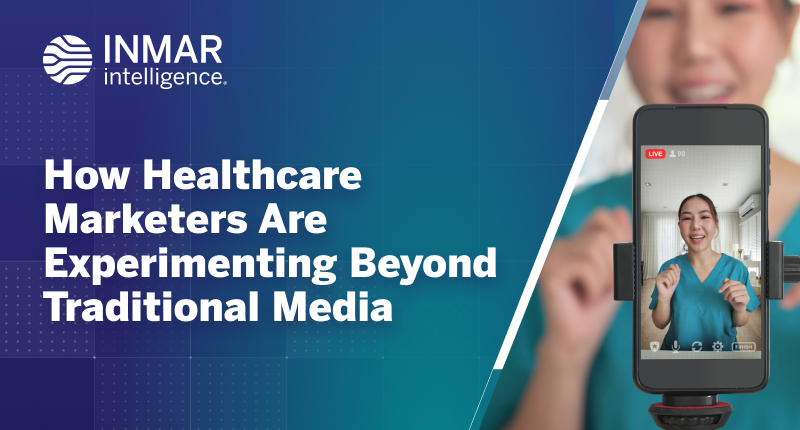
For years, healthcare media strategies have relied on a familiar playbook: clinical journals, point-of-care platforms, professional portals, and tightly controlled programmatic buys. In a highly regulated industry, these environments have offered safety, control, and predictability.
But predictability isn’t the same as effectiveness anymore.
The reality is, healthcare professionals don’t live inside endemic media ecosystems. Many physicians have built influential voices far beyond the exam room. They stream content, attend live events, move through media-saturated environments, and engage across multiple screens throughout the day.
Patients do the same.
Yet much of healthcare media still treats these audiences as if they only exist within clinical moments. That disconnect is exactly why forward-thinking brands are starting to rethink where, and how, they show up.
Why Healthcare Marketers Are Expanding Their Playbook
The shift isn’t just about chasing new channels for the sake of it. It’s more about aligning with how people actually consume media.
Digital out-of-home (DOOH) and connected TV (CTV) are gaining traction because they meet audiences in high-attention, real-world environments. DOOH shows up in the flow of daily life—airports, pharmacies, city centers—reinforcing messaging in moments that feel natural, not forced. CTV delivers premium, long-form storytelling within streaming environments, where attention is intentional and targeting is increasingly precise.
At the same time, brands are stepping into live experiences and sports environments. Spaces healthcare has historically avoided. These aren’t fringe experiments; they are high-engagement ecosystems where audiences are present, attentive, and primed for connection.
The opportunity is clear: these channels collapse the traditional divide between HCP and consumer engagement. They create a more unified, real-world brand experience that reflects how decisions actually get made.
What’s Holding the Industry Back
If the opportunity is so clear, why isn’t everyone doing it?
Because healthcare still defaults to caution.
Compliance and measurement concerns are valid, but they’ve also become a convenient reason to stay within legacy channels. The industry often equates “safe” with “effective,” even as audience behavior continues to move beyond those boundaries.
The result? Brands risk over-investing in environments that feel comfortable, but increasingly incomplete.
Evolving the Healthcare Media Mix Without Losing Control
The most effective healthcare marketers aren’t abandoning endemic media. They’re challenging its limits by layering in channels like CTV and DOOH to extend reach into real-world contexts without sacrificing compliance or credibility. They are designing campaigns that reflect the full journey of both patients and providers, not just isolated touchpoints.
And importantly, they are approaching this shift with intention. Audience-led planning, clearly defined channel roles, and measurable outcomes ensure that experimentation is structured and not risky.
This is where the right partners matter. Navigating regulated healthcare marketing while activating across broader media ecosystems requires both precision and perspective. When done right, brands can expand confidently, knowing their strategies remain compliant, measurable, and fully connected.
Healthcare audiences have already moved beyond traditional media. Will healthcare marketing will keep up?
Curious what your media strategy could look like beyond endemic channels? Fill out the form and let’s talk about how to make it real.