
It’s easy to think of crash cart management as a routine task, something that just needs to get done. But the cost of getting it wrong adds up quickly and not always in ways that are immediately visible.
At a system level, the impact is significant. According to the National Institutes of Health (NIH), preventable adverse events in U.S. hospitals cost roughly $20 billion annually. That number reflects large-scale issues, but they’re often rooted in small gaps: missed details, incomplete verification, or processes that assume accuracy without fully confirming it.
Where Small Gaps Become Real Costs
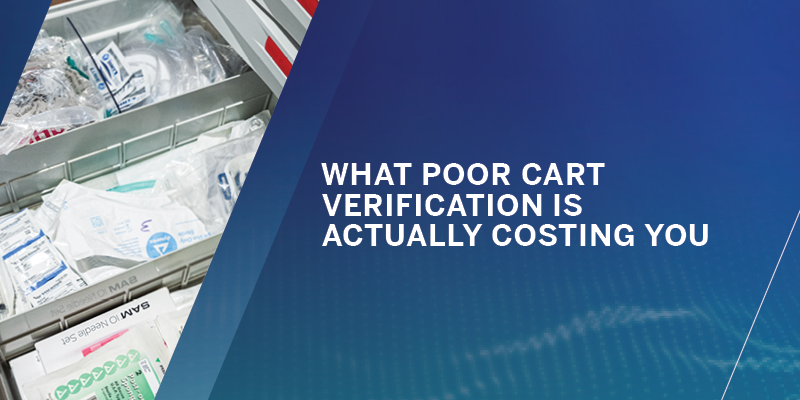
In cart-based workflows, those gaps show up in practical ways. A medication that’s expired but still sitting in the tray. An item that’s present but not where it’s expected. A recalled medication that never got pulled because the process depended on staff catching it manually.
On their own, these gaps may seem manageable. Over time, they introduce rework, delay, and uncertainty. Teams double-check carts that were already “verified.” Items get replaced prematurely, reordered unnecessarily, or worse, missed entirely.
And as hospital costs continue to rise, even small inefficiencies become harder to absorb. The American Hospital Association (AHA) says spending on supplies alone increased by nearly 10% just last year; drugs by 13.6%. When verification isn’t complete, waste doesn’t just happen, it compounds across the entire cart.
The Hidden Cost of Rework
One of the least visible costs is the time teams spend compensating for gaps in the system. When verification stops at identification, staff are left to fill in the rest: checking placement, confirming expiration dates, and validating completeness across both trays and supply drawers. That work doesn’t disappear; it just shifts.
Because it’s absorbed across teams and workflows, it’s rarely recognized as a formal cost. But it shows up in slower replenishment cycles, inconsistent cart readiness, and additional labor spent compensating for gaps in the process. Across an entire cart, those small gaps multiply.
When Accuracy Becomes Assumed
The bigger issue isn’t just cost, it’s confidence. When a process appears consistent, it’s easy to assume it’s also accurate. But if the system isn’t verifying the details that actually matter, that confidence can be misplaced.
In crash cart environments, that matters. Clinicians rely on the expectation that what they need—whether in the medication tray or a lower supply drawer—is there, in the right place, and ready to use. If the system can’t fully support that expectation, the cost isn’t just operational; it becomes clinical.
Rethinking the Cost of Verification
Most discussions about cost focus on technology, what it takes to implement or maintain. But the more important question is what happens when verification falls short.
The cost shows up in wasted supplies, repeated labor, delayed workflows, and, in some cases, preventable harm. These aren’t separate issues. They’re all connected to how accuracy is defined and verified across every crash cart in the entire system.
A More Complete View
As pharmacy operations evolve, the conversation is shifting. It’s no longer just about whether a process is automated. It’s about whether that automation is verifying the right things, and whether it’s giving teams a complete and accurate picture of the cart across both pharmacy and supply workflows. Because in the end, the goal isn’t just to move faster. It’s to eliminate the gaps that create cost, rework, and risk in the first place.