
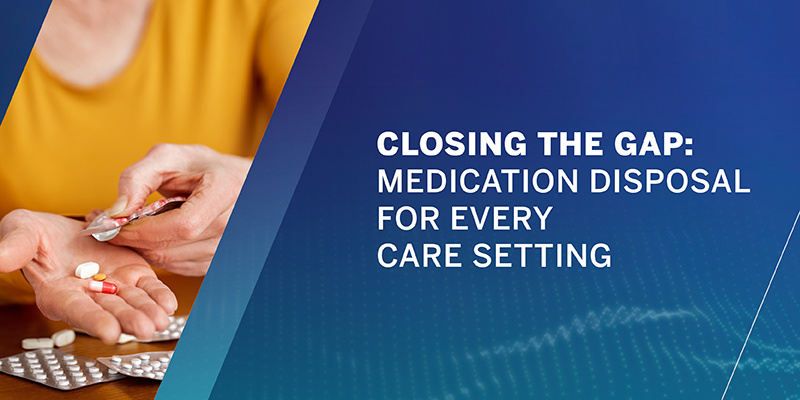
Unused medications remain a persistent problem across the healthcare system. They collect in medicine cabinets, discharge packets, long-term care settings, pharmacies, and homes for all kinds of routine reasons. A prescription changes. A patient improves. A therapy ends early. Extra medication goes unused. And once it is no longer needed, what happens next is often unclear. That uncertainty matters.
For years, the conversation around medication safety has centered on prescribing, adherence, and access. Those are important issues. But the point at which a medication is no longer needed deserves more attention than it typically gets. When unused drugs are left behind without a simple, responsible path for disposal, the risk does not disappear. It simply takes a different form.
Understanding the Disposal Gap
Once a medication is no longer needed, several things tend to happen.
It may be kept at home, often with the intention of saving it “just in case.” It may be thrown in the trash. It may be flushed down the drain. In some settings, it may sit in a drawer, cabinet, or supply room until someone has time to decide what to do with it.
Each of those outcomes creates its own set of concerns. Leftover medications in the home can increase the risk of misuse, diversion, and accidental poisoning. Improper disposal can introduce pharmaceutical compounds into landfills, waterways, and the broader environment. And in healthcare settings, unclear or inconsistent disposal processes can create operational, compliance, and safety challenges.
The problem is not that the industry lacks awareness. The problem is that disposal is still too often treated as one issue with one answer.
Why One Disposal Method Is Not Enough
Medication disposal does not happen in a single setting, and it does not involve a single type of product.
A patient recovering at home after surgery has different needs than a manufacturer supporting a therapy program. A caregiver managing injectable medications faces different challenges than a hospital unit. A retail pharmacy, a clinic, a long-term care facility, and a life sciences organization all approach disposal from different starting points.
That is why one-size-fits-all thinking falls short.
Traditional take-back programs continue to play an important role. Permanent collection sites and take-back events all help remove unused medication from circulation. They create awareness, support responsible disposal, and give consumers an alternative to keeping or discarding medications improperly.
But those channels do not solve every scenario. They are not always immediate. They are not always convenient. And they are not always designed for the way medication is actually used, left over, and managed across different care settings.
The Public Health Impact
Unused medications create real public health risks.
Leftover drugs in the home can become an easy source for misuse. They can be taken accidentally by children. They can remain mixed in with current medications, creating confusion for patients and caregivers. And the longer they remain accessible, the greater the chance they will be used, shared, or discarded inappropriately.
This is especially important in the context of opioids and other controlled substances, where unused medication can quickly become a diversion risk. Even when the intent is harmless, the outcome may not be. A medication kept for later can become a medication used incorrectly. A prescription that was meant for one person can end up affecting someone else entirely.
Safe disposal helps interrupt that chain before it starts.
The Environmental Consequences
The impact of improper disposal extends beyond the home.
When medications are flushed or thrown away without the right safeguards, their active ingredients can enter the environment. Wastewater systems are not designed to remove every pharmaceutical compound, and discarded drugs can make their way into water supplies, soil, and ecosystems over time.
That makes disposal not only a safety issue, but also an environmental one.
As healthcare organizations and manufacturers place greater emphasis on sustainability, medication disposal deserves a place in that conversation. The end of the medication journey has consequences, and how that stage is handled matters just as much as the packaging, distribution, and use that came before it.
A More Practical Approach to Safe Disposal
The most effective disposal strategies reflect the reality that different situations require different options.
In some cases, drug deactivation makes the most sense. Giving patients or providers a way to render medication unusable at the point it becomes waste can reduce diversion risk quickly and simply.
In other cases, mail-back programs offer a better fit. They can provide a compliant, trackable way to return unused medications for secure destruction, particularly when oversight, reporting, and verification are important.
Sharps create another category entirely. As more injectable therapies move into home and outpatient settings, the need for safe sharps disposal continues to grow. Patients, caregivers, and sanitation workers all benefit when there is a clear, accessible system for handling used sharps safely.
These are different challenges, but they point to the same conclusion: safe medication disposal works best when it is flexible enough to match the setting, the product, and the behavior involved.
Making Disposal Part of the Care Journey
Too often, disposal is treated as something to think about only after everything else is done. But it works better when it is considered earlier, as part of the broader care journey. It should be built into patient education, discharge planning, product support programs, and operational workflows wherever appropriate.
When disposal is made visible, simple, and convenient, people are more likely to follow through. When organizations plan for it upfront, they can reduce risk, support compliance, and make the process easier for the people they serve.
That shift matters because safe disposal is not just about getting rid of what is left over. It is about reducing the chances that leftover medication becomes someone else’s problem.
Looking Ahead
The need for safe medication disposal is not new, but the expectations around it are changing.
Healthcare organizations are being asked to improve safety, reduce friction, support sustainability goals, and strengthen compliance all at once. Patients are managing more care at home. Manufacturers are looking for better ways to support the full therapy journey. And across the industry, there is growing recognition that disposal should not be an afterthought.
The path forward is not to rely on a single method. It is to make disposal easier, more practical, and better aligned to real-world use. That means offering solutions that work across drug forms, care settings, and patient behaviors. It means recognizing that pills, liquids, and sharps do not create the same challenges. And it means treating the end of the medication journey with the same level of attention as the beginning.
Safe medication disposal works best when it is convenient, routine, and built for the setting in which it will actually be used.
For organizations looking to strengthen that approach, Inmar’s new Safe Med Disposal Suite brings together Inmar Drug Deactivation and Disposal powered by Deterra®, mail-back envelopes, and sharps container programs to support safe, responsible medication disposal across care settings—in addition to the Consumer Drug Take-Back kiosk program.
For more information, fill out the form below.