
SHARED RESPONSIBILITY AS TECHNOLOGY SHAPES COMMERCE
At FMI GroceryLab this year, we analyzed an increasingly pressing issue for consumers: affordability.
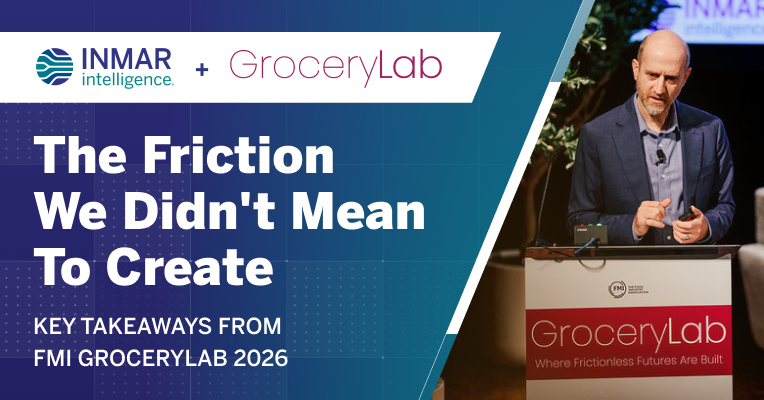
During our Founding partner speaker session titled “The Friction We Didn’t Mean To Create,” Orr Orenstein, SVP of Artificial Intelligence at Inmar Intelligence details how grocery leaders can use AI-enabled pricing and predictive analytics tools to address the growing accessibility gap between shoppers and retailers.
The discussion was structured around industry progress, consumer cost barriers, design complexity reduction, AI-based pricing strategies using store-level and health data, and delivering value to consumers more fairly and equitably.
Here are a few takeaways from the session:
RISING COSTS BUILD AN AFFORDABILITY CRISIS
Rising food prices have accelerated the current affordability crisis, forcing Americans to sacrifice and swap what’s in their grocery basket. While Orenstein describes himself as “the AI guy,” he explains the fundamental nature of this issue is a human one. Advancements in technology should be positioned as a tool for improving retail affordability, accessibility, and an overall more effective customer experience.
"The more technology shapes commerce, the more responsibility, or opportunity we have to support the people moving through it," Orenstein says. If there is an opportunity to shape the future we want rather than the one we are given, we should ask ourselves: Are we serving those who need it? Are we giving consumers opportunities to make healthy and affordable choices?
FRAGMENTATION IN THE CURRENT SYSTEM
Fueled by industry pressure to innovate and automate, today’s grocery system has expanded with sophistication. New channels, personalization, targeting, and measurement capabilities were created to influence the shopper journey. However, in efforts to capture an expanding network of touchpoints, the experience has become more fragmented, leaving millions of consumers still struggling to access the value these systems were designed to deliver.
"Not because the value doesn’t exist. Because the system increasingly assumes digital fluency, time, attention, and access that isn’t always there," Orenstein says. There is opportunity for brands and retailers to simplify the process. The next wave of innovation must make value more accessible, more intuitive, and more equitable for the shopper by meeting them where they are.
AFFORDABILITY DRIVES DECISIONS
Apart from this type of disparity between shopper and retailer, rising costs create another type of barrier. Right now, Americans are faced with high prices and even higher demands, leading them to shrink their baskets. According to current affordability surveys, the majority of Americans cite food as their top expense pressure. This issue has also been exacerbated by the recent lapse of the SNAP program, affecting millions of Americans.

Orenstein presents a heat map of SNAP EBT usage across the United States.
Outside of groceries, consumers are facing additional trade-offs due to higher energy costs, dwindling healthcare access, inflation, and wages that have not kept pace with cumulative household cost pressures for many consumers. Consumers need “incentives and relief, not bigger asks,” according to Orenstein.
An Inmar proprietary consumer behavior report revealed that 59% of consumers spend significant time looking for deals. These trends reveal that affordability is driving change in consumer purchasing patterns. While some shoppers have made adaptations, many lack the time, digital access, or budget flexibility to navigate increasingly complex value systems.
TAILORING RETAIL PRICING WITH AI
While many companies do have great community support programs, Orenstein challenges these companies to go past the ‘easy’ commitment numbers and look at the lived realities of specific communities and shopper segments. If consumers aren’t able to afford to purchase these products, how will that impact what companies can give back? Retailers can use AI and predictive analytics to better align pricing, promotions, assortment, and incentives with the needs of each store’s community.
Looking beyond just pricing strategy, this method can also be used to benefit the health of communities. By using aggregated public health and community need indicators, retailers can also identify areas where there is a need for access to fresh food. Incentives for fresh and healthy food can be channeled toward communities with identified higher health risks. “It’s not just about discounts, it’s about healthier lives and communities,” Orenstein says. This is critical to the wellness of communities, especially as consumers face growing pressure across food, healthcare, and other essential household needs.
USING INNOVATION FOR COMMON GOOD
As lawmakers increase scrutiny of AI-enabled and personalized pricing, especially where consumer data could be used opaquely or unfairly, Orenstein argued that the industry should not treat regulation as a reason to stop innovating, but as a mandate to design pricing models that are transparent, ethical, and centered on need. "With AI, we can create fair, need-based pricing, ensuring those struggling most receive the greatest support," he says.
Orenstein poses the question: instead of banning and opposing the use of AI, what if businesses were all committed to using it ethically for the greater good? Rather than undoing innovation, moving towards a predicated understanding of the human experience that resides beneath the technology.
WORKING TOWARD REDUCING FRICTION
As these issues continue to persist, it is imperative to reduce fragmentation across channels. The retail experience must be flexible and continuously improving as shopper realities evolve. Orenstein encourages businesses to look past traditional KPI metrics to the actual experiences of the consumers we serve to ensure value reaches beyond only the most digitally fluent and engaged customers.
Did you miss the session at GroceryLab, but want to know more about using artificial intelligence and predictive tools to build data-based, accessible pricing strategies? Fill out the below form to connect with a member of our team and learn more.